
Searching the Jefferson Court Docket
Don't look for a town-run docket database. Jefferson doesn't have one. Every Jefferson case lives in the statewide eCourts Portal. That portal picked up Ashe County after its eCourts conversion. Smart Search accepts a record number, party name, citation number, attorney details, a business name, a cross-reference number, or even a nickname. Treat "Jefferson" as a search term the court system may control. It is never its own jurisdiction or a guaranteed filter.
A full record number is the cleanest way in. The public result opens the Register of Actions, sometimes labeled the Case Summary, which gathers the public entries from the clerk's record. No number handy? A party-name search works too, though wide results may force you to filter by location, case type, status, or filing date. Remember that date-of-birth display is masked, so a results list proves nothing about identity.
- Keep the Jefferson citation, notice, summons, or case number available before starting the court search.
- Open Smart Search in the eCourts Portal and enter the complete record number, or use the documented last-name, first-name sequence.
- Apply Ashe location and available case-type, status, or filing-date filters when a Jefferson name search is too broad.
- Open the underlined case number to review the Jefferson-related Register of Actions and any available hearings, disposition, or financial sections.
- Call or visit the Ashe Clerk when the Jefferson result is absent, restricted, old, or needed as an official copy.
Note: The Portal caps results at 200, so a broad Jefferson name search may need tighter court filters before the list turns useful.
Jefferson Court Portal Search
The official Portal guide lays out every field a Jefferson court record search can use. Smart Search demands one basic criterion first. Only then do the Advanced Filter Options tighten the pool. That order matters here. A Jefferson incident often produces a case file sitting in the Ashe County state-court system.
| Jefferson court-search field | Use | Limit |
|---|---|---|
| Party Name | Search a Jefferson-related public case when no record number is known. | Use the documented name order; broad results may need filters. |
| Record Number | Locate one court matter directly. | Use the complete Odyssey number when it is known. |
| Citation Number | Check a Jefferson citation that reached Ashe District Court. | Availability and public access can vary by case. |
| Location and case filters | Narrow a Jefferson search to Ashe and a relevant type or status. | Filters refine a basic query; they do not search alone. |
Record numbers generally follow YYTT######-040, and 040 is Ashe County's code. Treat that pattern as a sanity check. It is not a substitute for the number printed on your Jefferson court notice. NC Judgment Search, meanwhile, is just an index snapshot. For the fuller picture, run Smart Search. Confirm any current total or official document with the clerk. A Jefferson case that calls for deeper county-level fields fits the Ashe case lookup well.
Jefferson Municipal Court Basics
Jefferson runs its cases through the North Carolina General Court of Justice at the Ashe County courthouse. It does not use any town court. The Ashe Clerk and the state's court tools handle anything tied to Jefferson. The town posts no municipal court calendar, no municipal docket, and no portal for paying a town citation. Being the Ashe County seat does not change that. The court side of Jefferson life simply belongs to the county and the state.
For scale, the 2024 state municipal estimate puts Jefferson at 1,638 residents. That makes it the largest incorporated town in the county. The figure describes the town itself. It says nothing about Jefferson court filings, citations, or enforcement numbers.
Need to reach the town government? The Town of Jefferson contact page points you to Town Hall. That office handles municipal business rather than court records.
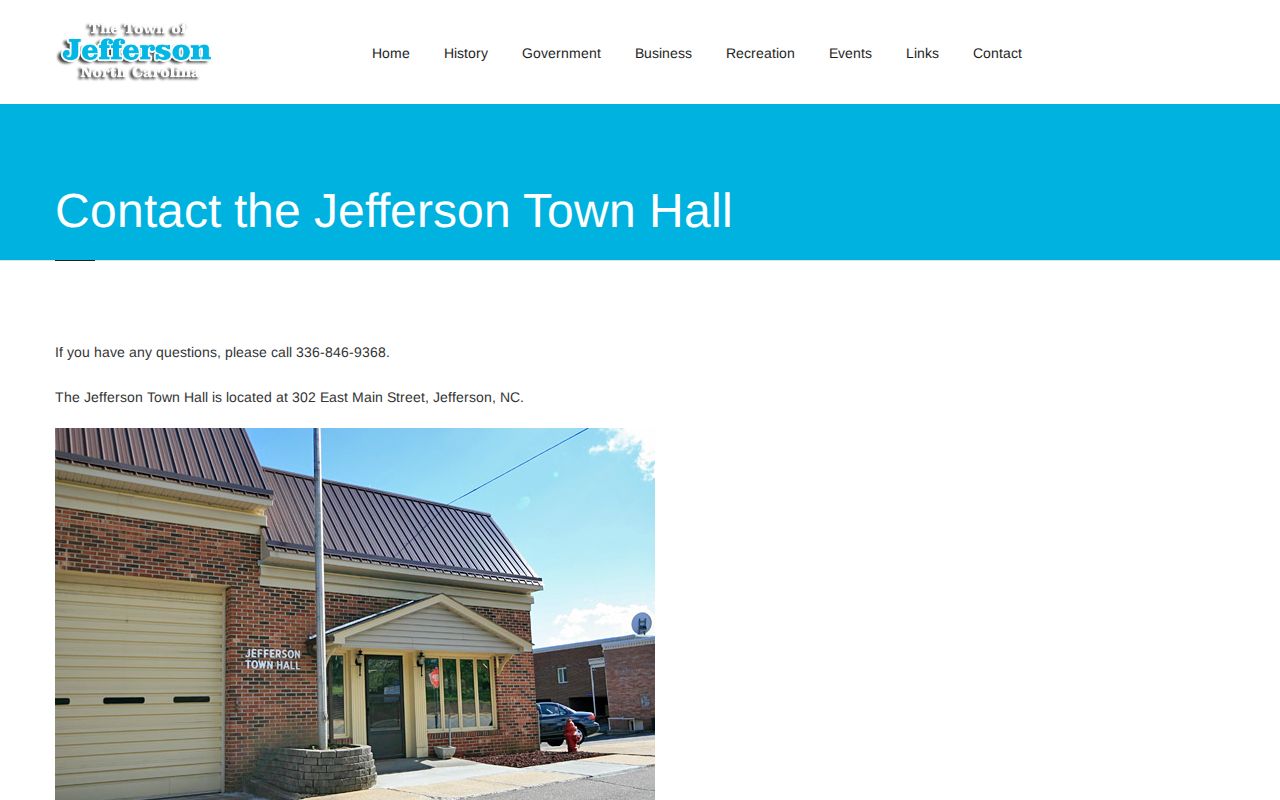
Town Hall sits at 302 E. Main Street, Jefferson, NC 28640, and the town phone is (336) 846-9368. That office handles town-government business and nothing more. It keeps no Jefferson court record, no state-court calendar, and no court payments. Those all run through Ashe County.
Jefferson Town Hall Versus Court Counter
A town contact and a court custodian do different jobs in Jefferson. The official town page and the police department page can connect you with municipal or enforcement staff. Neither one opens a court counter. Once an incident becomes a state court matter, the file, docket summary, hearing route, and certified-copy path all stay with the Ashe County Clerk of Superior Court.
The Jefferson Police Department page is there for agency contact. It is not a Jefferson docket portal.
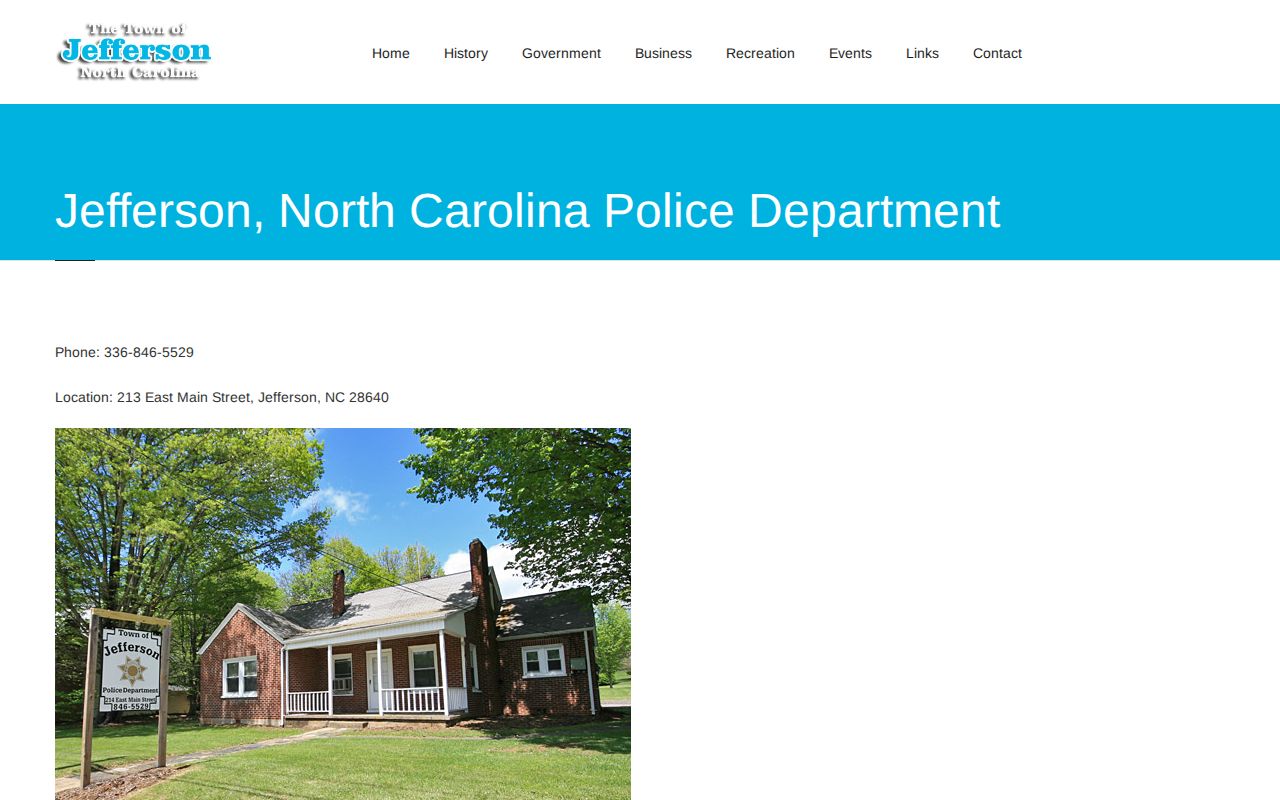
The police department is listed at 213 E. Main Street, Jefferson, with telephone (336) 846-5529. Call there for an enforcement question. Just don't expect the agency to certify a Jefferson court document or confirm a state-court setting. The clerk does that. The working path runs from your citation through the Portal and calendar to the Ashe Clerk.
Jefferson's county-seat story starts in 1799, with incorporation following in 1854–55. Those dates are town history, not court service. The historic courthouse and museum context stands apart from the working Judicial Branch location. That location handles present filings and records.
Court Dates and Settings in Jefferson
Every Jefferson court date is an Ashe County state-court setting. Start with the written date. Pull it from your citation, summons, or Register of Actions entry, because that document preserves what you were told. The Portal's Search Hearings function then takes over. It queries by case number, party, business, attorney, judicial officer, or courtroom, and it needs three inputs: the Ashe location, a hearing type, and a date range.
A Jefferson court calendar result helps. It never replaces a current notice or clerk confirmation. Schedules come from the official state calendar service. Civil and criminal county schedules are separate there, and a Jefferson criminal or traffic matter belongs on the Ashe criminal side. The Register of Actions shows a Hearings section only when information is available. A continuance is a postponement, while a reset is a later setting that replaces or supplements an earlier date.
| Jefferson-related date | Read it from the citation, notice, Search Hearings result, or available Register of Actions. |
|---|---|
| Time | Use the currently posted court setting; do not treat a legacy 12:00 AM display as a proven event time. |
| Location | Select Ashe County in Search Hearings because Jefferson has no separate municipal court location. |
| Hearing type | Choose the required Portal hearing type and then review the returned court information. |
| Setting status | Check whether the matter remains set, continued, reset, or otherwise changed, then confirm an unclear result with the clerk. |
Jefferson Court Date Confirmation
Some settings need a confirmation chain. That includes any Jefferson date that is close, confusing, missed, or hit by a closure. Check the Portal's Search Hearings information. Review the Ashe county calendar too. Compare both against your written notice. A published calendar can be revised, or it may show a whole session rather than an individual final notice. When sources conflict, the clerk confirms locally.
Call the Ashe County Clerk of Superior Court at (336) 219-1400. Go to 150 Government Circle, Jefferson, NC 28640. That is the current courthouse, not the historic one or a town office. If you missed a setting, contact the clerk promptly about local procedure rather than trusting an old Jefferson calendar row for current status.
Jefferson date check: Portal and calendars are useful court-search tools, but the Ashe Clerk is the documented local route for a changed, canceled, or time-sensitive setting.
Traffic Tickets in Jefferson
A Jefferson traffic ticket that goes to court travels the Ashe County District Court route. There is no town traffic-court docket. Hold onto the citation number and the assigned date on your ticket. Search the Portal by citation number or record number. Check the Ashe criminal calendar for posted sessions. Take any time-sensitive question to the Ashe Clerk. The state warns that calendar listings may not show every schedule or immediate change.
The North Carolina traffic guidance explains that an eligible waiver or payment is a case-specific court response, not a town bill payment. You have three paths. Appear on the listed court date, use an approved eligible option if one is offered, or take the matter through the court process. An online payment screen does not guarantee eligibility.
The Judicial Branch's criminal case overview describes the state trial-court divisions that handle criminal proceedings.
Jefferson traffic records sit in the Ashe court system. Payment and court-record details are countywide. Find them under Ashe traffic tickets, and confirm any current setting through the Portal, the Ashe calendar, or the clerk.
Jefferson Citations and District Court
Ashe County District Court takes ordinary infractions and misdemeanors, including the state-court route a Jefferson citation follows. One clerk serves the whole county. The Clerk of Superior Court holds both District Court and Superior Court files. So a Jefferson citation can start with an officer or a town-related event. Its court record stays a county state-court record.
Cases can also move. A District Court criminal appeal can reach Superior Court. There it gets a trial de novo, meaning a new trial rather than review of the lower court record. It does not create a Jefferson appellate court. The Register of Actions can show a transfer or appeal status. The clerk can confirm the current court assignment.
Note: a court record is separate from a DMV driving record, even when a court disposition is reportable to the motor-vehicle agency.
Where Jefferson Cases Go
There is no town municipal court in this chain. Cases enter the Ashe County state-court structure at filing. Ashe County District Court handles misdemeanors, infractions, family and juvenile matters, and civil matters within its allocation. Ashe County Superior Court takes felony trials, civil matters above the District Court allocation, and authorized District Court criminal appeals. Both divisions share one county clerk route.
Court-record flow: Jefferson town-related incident or filing → Ashe County District Court or Ashe County Superior Court → Ashe County Clerk of Superior Court and eCourts Portal.
The Ashe County Judicial Branch location page identifies the current court hub in Jefferson. That matters for a Jefferson record search. Town government contacts serve municipal functions. The unified court system maintains the state-court file. Appeals governed by state procedure may proceed beyond the trial divisions to the North Carolina Court of Appeals rather than to a separate city court.
Jefferson Courthouse Mail Route
Mail for the clerk goes to Ashe County Courthouse. The address is 150 Government Circle, Suite 3100, Jefferson, NC 28640-9378. That Suite 3100 address works for paying an eligible citation by mail. It also serves as a general contact point. It does not create a town court or a general mail-copy service.
The Ashe payment information page sets the rules for mailed citation payments. Use a money order or certified check made out to Ashe County Clerk of Superior Court. Do not mail cash or a personal check. The same page also lists online and in-person options for eligible matters. What appears online depends on the case. Before mailing any Jefferson court payment, call the clerk and confirm the route and the amount.
Jefferson Court Record Access Rules
Two rules control Jefferson court record access. One is North Carolina law. The other is the Ashe clerk's custody of county case files. The public Portal shows available public information, while the courthouse supports inspection and official copies. Remember that the online Register of Actions is not the official court record. For a needed document, a certification, an older paper file, or a public result that never appears, go to the Ashe County Clerk of Superior Court. The Judicial Branch record-access guidance explains the public self-service terminal and clerk routes in detail.
A blank Jefferson docket search happens for lawful reasons. The case may sit in another county, lack indexing yet, be older, confidential, or sealed. A missing Portal result proves nothing about whether a court matter ever existed. Ask the clerk about the lawful access process. Do not assume the content is off limits.
Jefferson court-record rules:
G.S. 7A-109 requires clerks to maintain court records, files, dockets, and indexes and allows public inspection when the law does not prohibit it.
North Carolina Public Records Act, G.S. 132-1 defines public records and supports access subject to applicable confidentiality laws.
G.S. 7B-3000 restricts juvenile-record inspection unless statutory authority or a court order permits access.
Jefferson Portal and Clerk Records
Portal and the Ashe Clerk answer different questions about Jefferson court records. Portal is the fast public start. It offers an available Case Summary, events, hearing information, disposition, and financial information where those sections exist. The clerk holds the original file. The office handles certification, offers a public terminal review, and supplies what the online view does not. North Carolina eCourts File & Serve is a filing system, not the public docket search. The clerk fee statute lists statewide fee categories that may matter for a Jefferson court-record request.
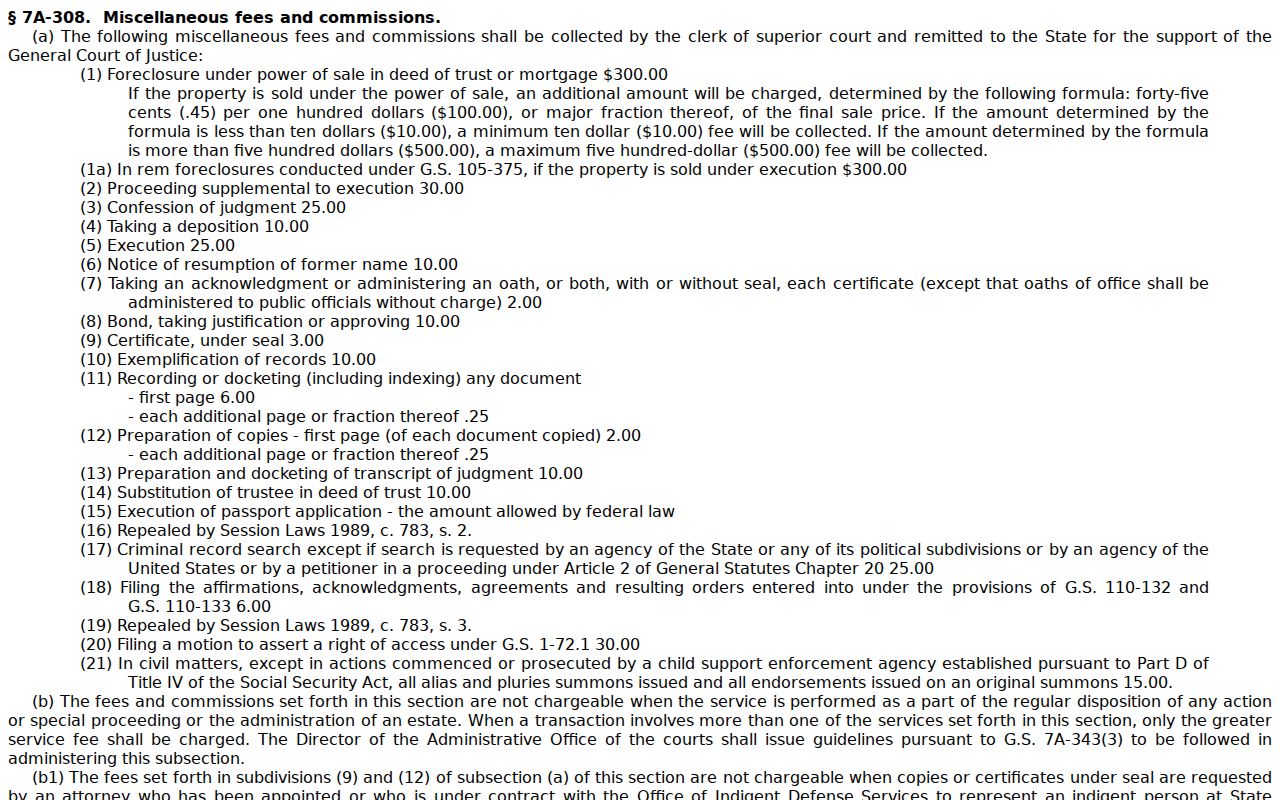
Under G.S. 7A-308, the categories include $3 for a certificate under seal and $10 for exemplification. There is also $2 for preparation of the first page of each document. Add 25 cents for each additional page or fraction. These are statutory categories. They are not a promise that every Jefferson document can be copied or certified at the same total. Confirm the copy type, current fee, and availability with the clerk. Do that before paying. The legislature's docket-access statute sets the clerk's record-keeping and public-inspection framework.
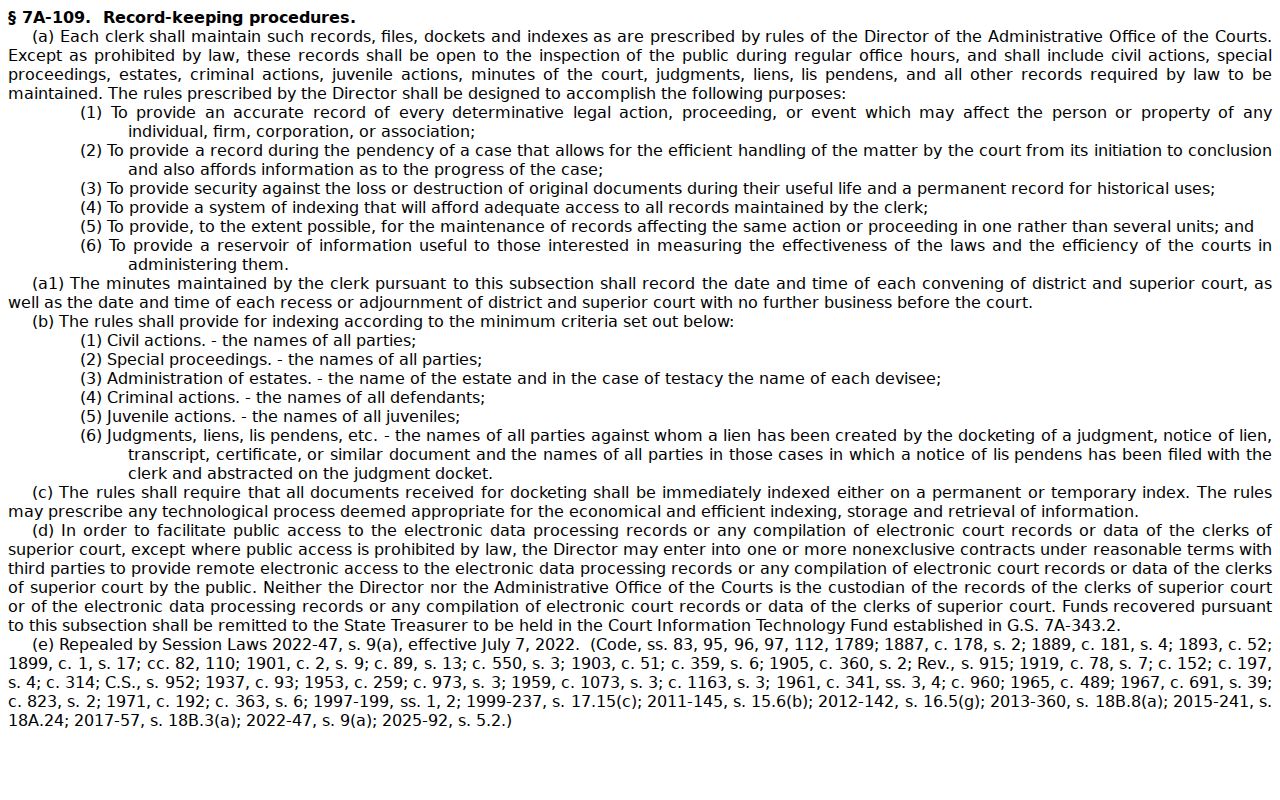
Jefferson court research works best when each channel stays in its lane. Town Hall and police contacts handle town or agency questions. eCourts Portal gives an available public summary. Calendars and Search Hearings show a setting. The Ashe Clerk holds the official court record. That split respects the town's real role. It also respects the state court's custody of the file.