
Searching Ashe County Civil Dockets
The official online route is the North Carolina eCourts Portal. Its Smart Search lets anyone look up available Ashe County case information without an account. Type a full record number for the tightest match. A party-name search takes last name then first, and filters can narrow the list. Click an underlined record number. That opens the Register of Actions, also called the Case Summary. Think of it as the Portal’s public view. It shows docket entries pulled from the clerk’s record, not a certified court file. Case numbers in Odyssey generally follow YYTT######-040. The last three digits mark Ashe County. That string is a format illustration only, not a live case. What about court dates rather than case history? The separate Search Hearings service or the Ashe civil calendar answers the question of a setting. When a result is missing, an official copy is needed, or a file is restricted, the Ashe County Clerk of Superior Court is the local path.
- Open Portal Smart Search and enter a full record number, or a party name in last-name, first-name order.
- Use Advanced Filter Options after the basic search to add a location, case type, status, filing date, or other supported criterion.
- Open the matching underlined record number and identify the case type, status, public entries, and available hearing section.
- Check Search Hearings or the Ashe civil calendar when a current setting needs separate confirmation.
- Contact the Ashe clerk for an available file, official document, certification, or a lawful answer about a result that is not public.
Ashe County Civil Search Types
There is no separate Ashe County civil clerk database. The Portal holds the county’s public civil information along with the other eCourts case types, so picking the right category beats hunting for a different local site. Official guidance lists Civil General, Civil Magistrate, Civil Foreclosure (CV), Civil Foreclosure (M), Confession of Judgment, Summary Ejectment, Civil Domestic categories, estate, and special-proceeding options. Advanced filters refine a basic query. They cannot run as a stand-alone search.
| Search field | Ashe civil use | What it helps distinguish |
|---|---|---|
| Basic criterion | Full case number or party name. | The starting point for every Smart Search query. |
| Case Type | Civil General, Civil Magistrate, foreclosure, domestic, estate, or special-proceeding categories. | The court-record path, not a separate clerk office. |
| Case Status | Pending, Appealed, Reopened, Stayed, Trial De Novo, transfer, or a disposition label. | Broad procedural position, not the full case history. |
| Location and filing date | Narrow a prior basic search to relevant records. | An Ashe-focused result when a name search is broad. |
eCourts went live in Ashe County on July 21, 2025, making the Portal the current electronic public-search route. eCourts File & Serve is a separate system where attorneys and parties file electronically; the Portal is the public view. A historic paper file or a document missing online is still a clerk-office question, even when Portal finds the case.
Inside an Ashe County Civil Docket
The Register of Actions works as an index to the public case timeline. It can show case information and party information. Case type and status, public dated entries, and hearing information may appear where the case has any. Civil, family, probate, and mental-health categories may also display Causes of Action when that data exists. Financial Information and Hearings show up only where there is something to display. Screen order can vary. Not every category appears in every civil case.
| Record number | The case identifier, often understood through the general YYTT######-040 Ashe County format. |
|---|---|
| Parties and case type | Public participant information and the Portal category used to classify the civil matter. |
| Register entries | The available public chronology of filings, orders, settings, and other docket events. |
| Causes of Action | Claim-category information for applicable Civil, Family, Probate, or Mental Health records when present. |
| Status and judgment material | A current procedural label and available information, not an automatic substitute for the filed judgment or clerk-certified record. |
Need the complaint, an order, a judgment, an exhibit, or a certified copy? The clerk route is the answer. The North Carolina court-records guidance names the clerk’s office in the county where the case sits as the access point for available files and copies.
Ashe County Civil Cases Above $25,000
Case type drives where a case lands. Official Judicial Branch material puts general civil matters above $25,000 in Superior Court. District Court handles civil matters within its statutory allocation. Magistrates, as District Court officers, generally hear small claims under $10,000. The state court-types overview gives the jurisdiction context. In practice, Ashe County’s records route still runs through the Clerk of Superior Court. The Portal is the other stop. Probate and estate records are a different animal. The clerk holds original probate jurisdiction in the Superior Court Division. An estate search is not a Civil General case. Let a record’s assigned type guide the Portal filter and the clerk request. It tells you nothing about the claim, the result, or the value of a matter. The current court division and the Register entries say far more about a case’s path.
- Civil General
- A Portal category for civil matters allocated outside the magistrate classification.
- Civil Magistrate
- A category associated with magistrate-level civil work within the unified District Court record system.
- Trial De Novo
- A status label that requires the case’s entries and clerk confirmation to understand its current route.
Civil Case Types on the Docket
A civil docket covers more than one kind of claim. Use the Portal’s actual case-type label. Don’t assume every civil record follows the same route. The state’s official choices show the mix an Ashe County civil search may pull up. The clerk keeps the files either way. The type may point to a magistrate, a District Court matter, a Superior Court civil case, or a special proceeding.
- Civil General matters.
- Civil Magistrate and small-claims matters.
- Civil foreclosure categories and confessions of judgment.
- Summary Ejectment and non-domestic restraining-order categories.
- Civil domestic, estate, guardianship, trust, and special-proceeding categories where the Portal lists them.
Public fields differ by case type. Causes of Action may be available for Civil, Family, and Probate or Mental Health matters, while the Hearing and Financial Information sections appear only when information exists. The category narrows the search. It does not unlock sealed or sensitive material.
Ashe County Civil Calendar Choices
Three tools answer three different questions in Ashe County. A published civil calendar may list a county civil session. The Portal Register of Actions is the running public chronology for one case. Search Hearings hunts for a hearing date. It wants a search type, the Ashe location, a hearing type, and a date range before it returns anything. A calendar is a fine first look at the week ahead. It cannot replace a current case-specific setting. After any change it cannot replace the clerk's confirmation.
| Resource | Best question | Constraint |
|---|---|---|
| Ashe civil calendar | Is a civil session published for Ashe? | Posted schedules can change and may not list every event. |
| Register of Actions | What public actions and hearings appear on this case? | It is a public case summary, not the official file. |
| Search Hearings | What current hearing result matches known criteria? | It uses required filters and does not override a court notice. |
| Ashe clerk | Has a setting changed or does a court notice conflict? | Access and scheduling remain subject to court procedure. |
With a case number in hand, turn to the county’s Ashe County case lookup. It supplies the shared name-and-record-number search context. What if a notice, a calendar, and the Portal disagree? Then call the clerk. Picking whichever screen looks newest is a poor way to resolve a conflict.
Civil Docket Settings and Hearings
A civil setting is a court event placed on the schedule, nothing more. It does not predict that a case will reach trial on that day. Portal's Search Hearings lets you query by many fields. Case number, party name, business name, attorney name, attorney bar number, judicial officer, or courtroom all work. The official workflow still requires the selected location, a hearing type, and a date range. A case-specific Case Summary can include a Hearings section. That section appears when the system holds information for it.
Two common docket words deserve a plain explanation. A continuance is a postponement. A reset is a later setting that replaces or supplements an earlier one. Ashe's local rules page links local civil materials. Among them are a shared Superior Civil Case Management Plan and a civil Request To Calendar form. Those materials show that local calendar management exists. They promise neither a hearing date nor a result on any request.
Note: Before travel or a time-sensitive appearance, confirm an uncertain Ashe civil setting with the clerk at (336) 219-1400.
Ashe County Civil Request To Calendar
The Ashe local-rules page names several civil materials. Among them are a Request To Calendar form, a Report Of Case Settlement, and a Consent Order For Expedited Trial. The accompanying local civil plan still carries a legacy district label. Even so, the current court directory puts Ashe in District 34. Read that mismatch as a caution about labels on old documents. It is not proof of two separate court systems. A local form can point to a procedural route. Filing one never guarantees that the court will grant or schedule what it asks.
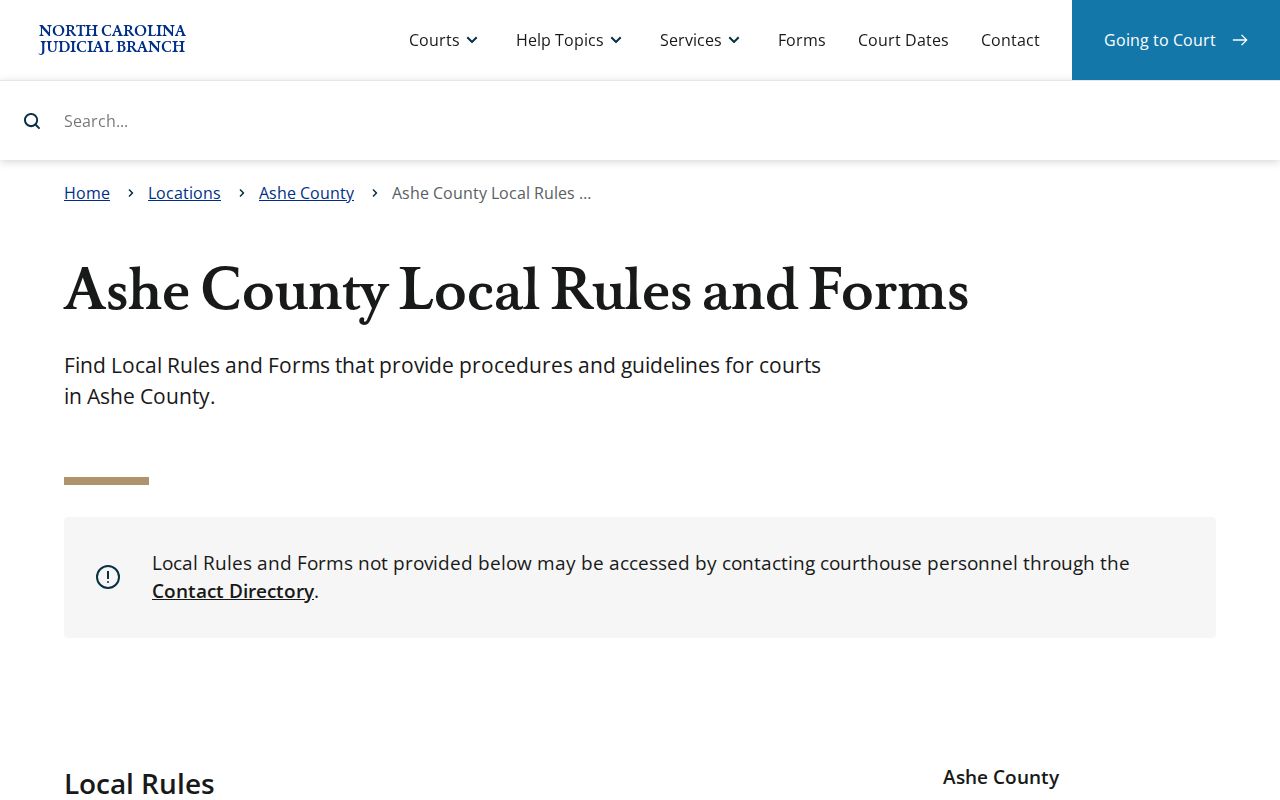
The Ashe County local-rules and forms page is where the court itself posts these civil materials.
Local rules tell you about procedure, not about your case. The public civil docket is a different thing entirely. Portal can surface available public entries, but the clerk and the court process control any filed document, current calendar action, or official record.
Civil Docket Access Rules
Where law permits, the clerk opens Ashe County civil records to public inspection, and Portal carries the online view of whatever public information is available. Two statutes do the framing here. G.S. 7A-109 requires the clerk to maintain records, files, dockets, and indexes, and G.S. 132-1 sets out North Carolina's public-record policy. Neither one entitles the public to see every piece of a case through Portal.
Key rules:
G.S. 7A-109 supports clerk record keeping and public inspection unless another law restricts access.
G.S. 132-1 sets the state’s public-record framework, subject to confidentiality rules and lawful redactions.
G.S. 1-72.1 provides a limited civil judicial-record access motion procedure and does not apply to juvenile proceedings.
One common mix-up involves the NCAOC public-record request. That route covers existing agency-held Judicial Branch records. It will not get you a copy of an Ashe civil case file. NCAOC is not the county case-file custodian. Plenty of content can lawfully stay out of a public result: sealed documents, confidential proceedings, juvenile information, and protected personal data, among other restricted material. Portal's Elevated Access is no public doorway to sealed files. So when an Ashe civil result comes back missing or partial, ask the clerk about the lawful access process. Do not infer facts from the silence.
Ashe County Civil Status Terms
Portal status labels describe broad procedural position and nothing else. They are not a narrative of the dispute. They also cannot stand in for the dated Register entries. The official guide gives examples. Pending, Appealed, Reopened, Stayed, Transfer to Another County, Transferred to Superior Court, Trial De Novo, and detailed disposition labels all appear there. Read a status alongside the case type, the public events, hearing information, and any official document. Obtain such documents through the clerk.
- Pending
- The matter remains open or awaits the next procedural action.
- Stayed
- The case is paused by an order or procedural status; the summary must be read for context.
- Reopened
- The Portal identifies a reopened procedural state, not a final explanation of why it changed.
A Portal status is one thing; an official judgment, certified copy, transcript, or audio record is another. The Ashe County Courthouse clerk offers a documented counter and a public self-service terminal path for available records. Call (336) 219-1400 to confirm current availability, restrictions, fees, or the right request process.