
Getting Ashe County Court Records
The fastest online route is the state eCourts Portal. Smart Search works there. It finds available public case information by full record number or by party name. Its Register of Actions, labeled Case Summary, is a chronological public summary drawn from the clerk's record. Use it to pin down the case, the division, and the document. Keep one point straight, though. A Portal result is not the official court record, and it cannot supply a clerk-certified copy.
For the official file, contact the Ashe County Clerk of Superior Court by phone, at the courthouse counter, or through the documented public-terminal route during office hours. The clerk offers no local court-document email address, fax line, copy-request form, or stated turnaround time. Mail serves one documented purpose: an eligible traffic payment. It is not a general copy-request method. The separate NCAOC public-record request route handles agency-held records. It does not replace the Ashe clerk as keeper of a county case file.
- Use the case number or party name to locate the Ashe County matter in Portal when public information is available.
- Name the exact item needed, such as a filed order, a plain copy, a certificate under seal, or an exemplification.
- Call the clerk or visit the courthouse counter to ask about availability, restrictions, current charges, and request handling.
- Use the public terminal or available paper-file route when an in-person inspection is appropriate.
- Request certification from the clerk when an official clerk-authenticated copy is required.
Note: A full record number makes any Ashe County court-record request far more precise than a broad name search.
Comparing Ashe County Court Records
Three different products get confused all the time. The Register of Actions is a public reference view. It is not the underlying item. A filed document is the real entry in the Ashe County case file. A certified or sealed clerk copy is an authenticated product that only the clerk supplies. Sort out which one you need before you call, so a Portal printout never stands in for a filed judgment or certificate.
| Record product | What it provides | Ashe County route |
|---|---|---|
| Register of Actions / Case Summary | Public summary of docket events based on the clerk's official record. | eCourts Portal Smart Search |
| Filed court document | Pleading, order, judgment, exhibit, or other item in the case file. | Ashe County Clerk of Superior Court; Portal document access varies. |
| Certified or sealed clerk copy | Clerk-authenticated official copy or certificate for a documented purpose. | Ashe County Clerk of Superior Court |
NC Judgment Search is an index, not a file. It is not the complete court record. When a judgment total, a signed order, or current official status matters, the clerk is the local confirmation point. That clerk serves Ashe County. Cases that began before Ashe County entered the eCourts system deserve the same caution. The official Ashe County Courthouse page lays out the local setting for court-record access.
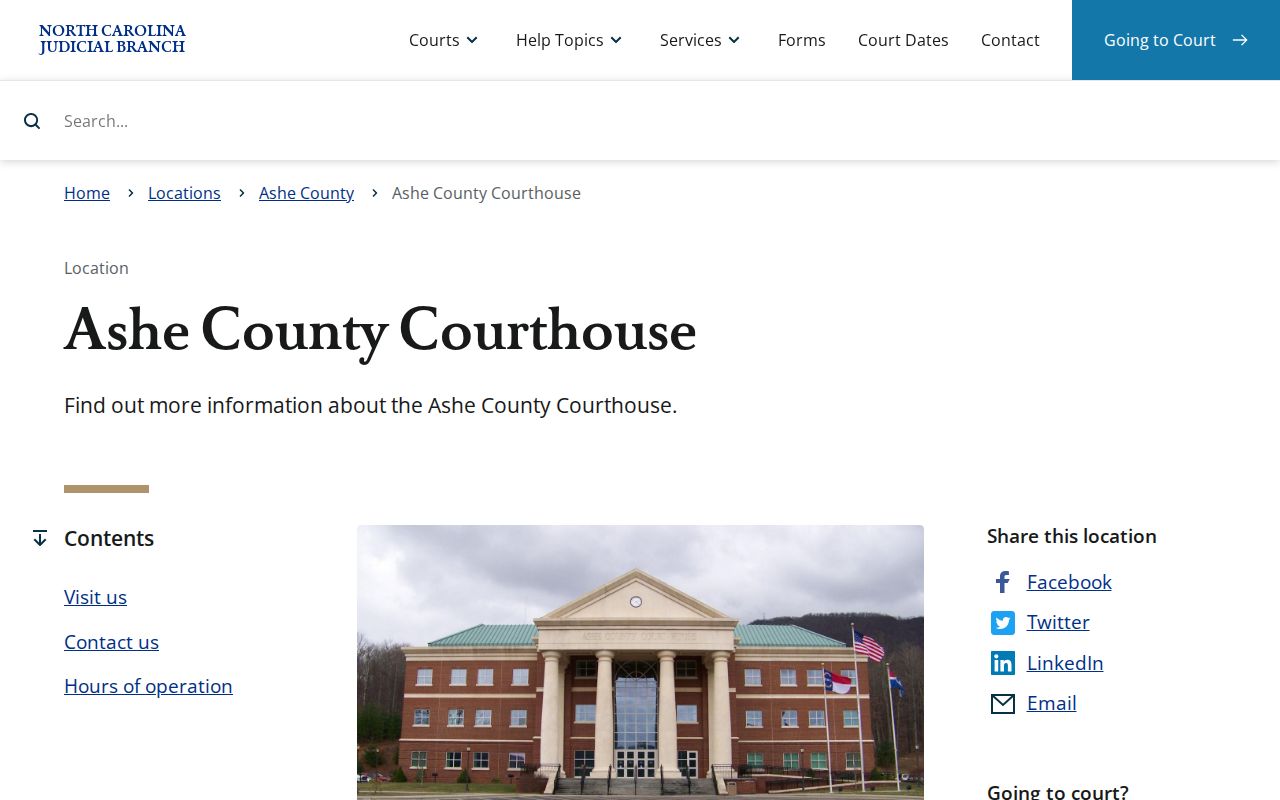
The courthouse is the in-person fallback. When an Ashe County court record is unavailable online or needs clerk authentication, the counter is where the request lands.
Court Record Types
One unified clerk system holds Ashe County court records. It draws from both Superior Court and District Court. That covers criminal, civil, domestic, estate, special-proceeding, and traffic or infraction matters assigned through the General Court of Justice. Magistrate small-claims and preliminary criminal activity route through the same system. Ashe County has no separate records office.
A Portal search may show public case summaries across these categories. Document display is controlled by case and document security. The clerk can say whether a filed item is open to inspection or copying. A case type names a category only. It never promises that every filing or attachment is public.
- Criminal and infraction case files, including available public docket events and dispositions.
- Civil, domestic, and special-proceeding files, subject to applicable access restrictions.
- Estate and guardianship records handled through the clerk's probate role.
- Orders, judgments, pleadings, and other documents filed in an Ashe County case.
- Hearing, financial, and cause-of-action information when the Case Summary displays it.
Ashe County Clerk Case Files
The Ashe County Clerk of Superior Court keeps the local case file. G.S. 7A-109 requires clerks to maintain court records, files, dockets, and indexes. It also supports public inspection where law permits. That statute explains the split. The Portal Register of Actions helps you locate a matter. The clerk still supplies the originals, copies, certifications, and help when a result fails.
The NCAOC public-record request form has one narrow use. It covers an existing Administrative Office of the Courts agency record. It is not the local case-file path. NCAOC's own request information says so. It directs a person seeking court documents or case information to the clerk. That is the clerk in the county where the case was filed. For an Ashe County court record, the Ashe clerk comes first.
Ashe County Clerk of Superior Court
Ashe County Courthouse
150 Government Circle, Suite 3100
Jefferson, NC 28640
(336) 219-1400
Monday through Friday, 8:30 a.m. to 5:00 p.m.
Official clerk contact directory
The official clerk directory lists the unified local contact for court-file questions, copies, and certifications in Ashe County.
Call before you make a special trip. An older file, a restricted record, or a needed certification can take extra time at the Ashe County clerk's office.
Inside an Ashe County Court Record
Each Ashe County court record starts with a case identifier. Filings, events, and rulings build the file from there. The Odyssey format uses a structure like YYTT######-040. The parts are year, case-type code, sequence, and Ashe's county identifier. The full number is the best search key. A name search can flood you with results. Narrow it with supported filters such as location, case type, status, or filing date.
Public summaries can expose case information, parties, Register entries, hearings, financial information, causes of action, and dispositions when data exists. Not everything shows. Sensitive fields can be masked, and documents can be withheld from the electronic public view.
| Case number | Identifies the matter; Ashe's county segment is 040 in the general Odyssey format. |
|---|---|
| Register of Actions | Portal's chronological public summary of docket events, not the official record itself. |
| Filed documents | Pleadings, orders, judgments, exhibits, and other items kept in the clerk file when available. |
| Hearings and status | Available case-summary information about settings, category, and procedural state. |
| Financial information | A Portal section when data exists; confirm current totals with the Ashe clerk. |
Ashe County Court Audio Requests
Audio and transcripts work differently from ordinary clerk copies in Ashe County. A reporter or digital recording technician captures the proceeding. A transcriptionist then types the transcript from that audio. Court reporters set their own rates, so there is no flat transcript price to quote. Some District Court criminal proceedings are not recorded at all, subject to exceptions the Judicial Branch identifies.
When a non-confidential proceeding has an available recording, the state's duplicate-audio form is AOC-G-114, and the charge is the actual cost of a CD. A confidential-proceeding transcript needs court permission first, through AOC-G-115. Ask the Ashe clerk which route fits your case. Neither form promises approval or availability on its own.
- Transcript
- A typed verbatim record prepared through the reporter or transcriptionist process, not a routine clerk-file copy.
- Audio record
- A recording, if one exists, that uses its own request process and remains subject to confidentiality rules.
- Certificate under seal
- A clerk-issued certificate that bears the court seal, distinct from a transcript or a Portal printout.
Copy Fees and Certification
Statewide fee categories come from the clerk fee statute, G.S. 7A-308. The statute separates plain copies from a certificate under seal and from exemplification. It does not publish one all-purpose Ashe County certified-copy price. So treat any such number as invented. Before paying anything, confirm the document, page count, restrictions, and delivery method with the clerk.
The $25 category covers a certified county criminal-record search when it applies. It will not look up a particular court docket. Nor will it hand you the filing in that case. Viewing and printing on the Portal may cost nothing. Still, a Portal view is not a certified court record.
| Clerk service | Statutory amount | Meaning |
|---|---|---|
| Certificate under seal | $3.00 | Clerk certificate bearing the seal. |
| Exemplification of records | $10.00 | Authenticated record service distinct from an ordinary copy. |
| Prepared first page of each document | $2.00 | Copy-preparation category for each document's first page. |
| Each additional page or fraction | $0.25 | Additional-page copy-preparation category. |
| Transcript of judgment preparation and docketing | $10.00 | Statutory judgment-transcript service. |
| Certified county criminal-record search | $25.00 | Applicable search service, not a case-specific docket lookup. |
Note: Ask the Ashe clerk to confirm current charges for multi-document, archived, audio, or certification requests.
Ashe County Portal Record Limits
Ashe County joined eCourts on July 21, 2025, in the Track 9 rollout. Portal is now the public electronic starting point. The clerk remains the official fallback for the file itself. The rollout changed how you get in, not who keeps the records. An older file may show up in Portal. Yet it may still need a courthouse request for an unscanned document, a paper record, or certification.
Sealed and confidential material stays out of Portal. A missing result tells you nothing about why. The case could be restricted, unindexed, older, filed elsewhere, formatted differently, or simply absent. Elevated Access is a formal role-based process for specified restricted information. It does not unlock sealed records for the public. Ask the clerk about the lawful route instead of guessing at a missing record's contents.
Portal limit: The Register of Actions is a summary of public docket entries based on the clerk's record. It is not the official court record and cannot replace a clerk-certified document.
Sealed Records and Public Access
North Carolina law generally lets the public inspect clerk-maintained court records during regular office hours. Another law can say otherwise. That promise does not reach every field, document, or case type in Portal results. Juvenile records are confidential. Sealed records carry limits. So do sensitive documents, protective-order and certain domestic-violence records, and confidential special proceedings. Take a lawful restriction to the clerk rather than trying to search around it.
For civil judicial records, a person claiming a right of access may have another option. That option is a limited-purpose court-motion procedure. That route never applies to juvenile proceedings. An expunction statute can also affect what the public sees. But a missing record alone proves neither an expunction nor that a case never existed.
North Carolina access rules:
G.S. 7A-109 requires clerks to keep court records and allows public inspection unless law provides otherwise.
G.S. 132-1, the North Carolina Public Records Act, states the state's public-information policy while preserving specific confidentiality laws.
G.S. 7B-3000 restricts public inspection of juvenile records absent statutory authorization or court order.
G.S. 1-72.1 provides a limited civil-judicial-record access-motion route.
Ashe County Historical Court Records
A historical Ashe County court record starts like a current one. It begins with the clerk and case identification. Portal offers the present electronic view. The Judicial Branch cautions, though, that not every historical record or document appears there. Some material may need a different route. That means files predating the local eCourts conversion, paper that was never scanned, and restricted material may still need the clerk-file or courthouse-terminal route.
Bring the fullest case number, party name, approximate case type, and date range you can. Then ask the Ashe clerk about location, public availability, copy options, and any current fee. The clerk posts no separate Ashe archive request form. The same goes for any local microfilm policy or off-site retrieval schedule. Start with the local record office. Don't assume an archive or statewide agency holds it.